

Project information
- Name: Mall Asset Readings Dashboard
- Type: Internship
- Project date: 18 Apr,2023
- Project URL: Github Link
Mall Asset Readings Analysis Dashboard
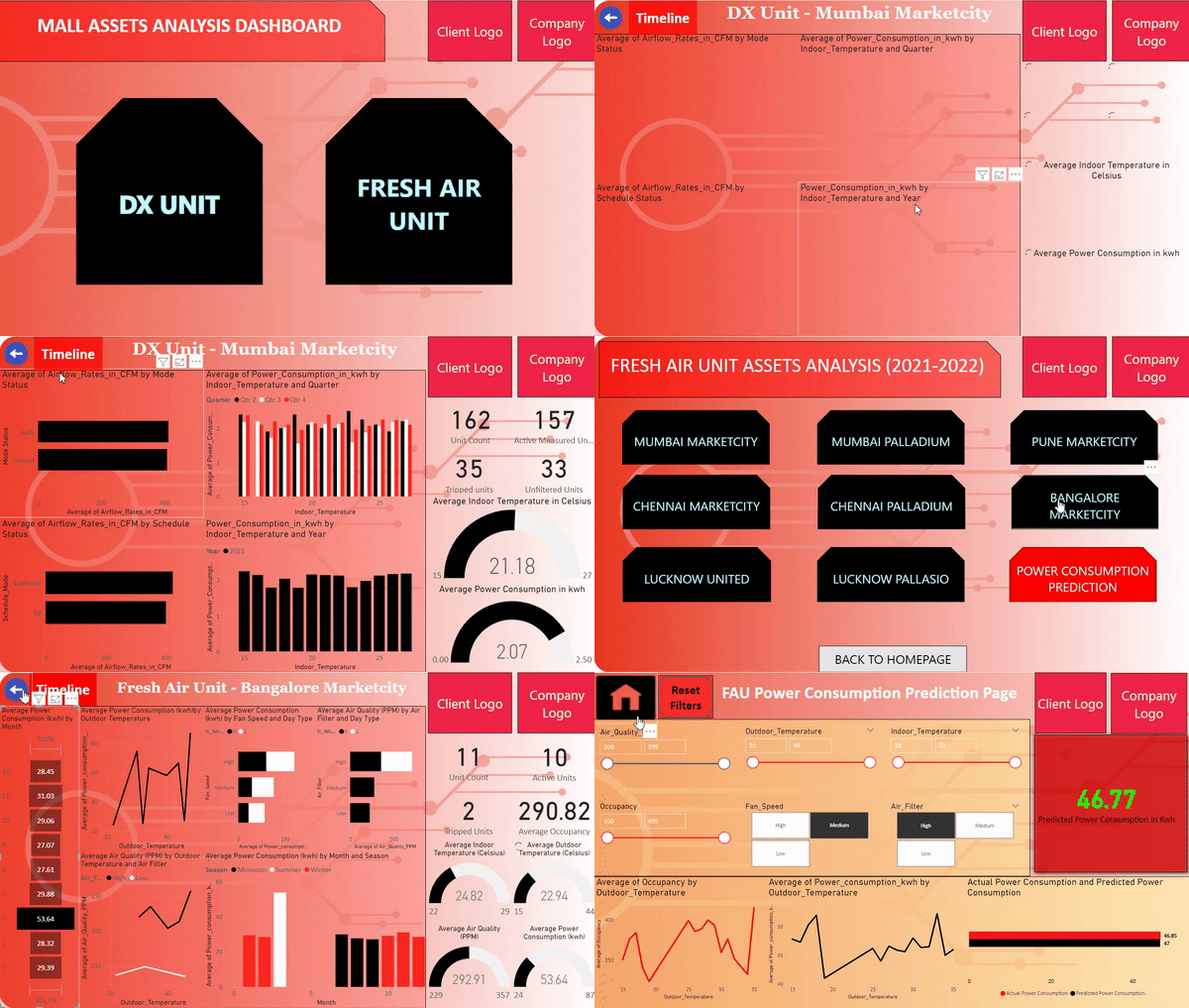
Project Overview
This repository presents an internship project that aims to create a comprehensive Power BI dashboard for analyzing and predicting readings and power consumption from DX (Direct Expansion) units and Fresh Air (FX) units in various malls across different cities in India. The project utilizes synthetic data to simulate real-life scenarios and demonstrate the practical applications of data analytics and predictive modeling in mall asset management.
-
The
data/folder contains the datasets, which includes various readings related to the mall ../assets such as On/Off Command, A/M Status, Run Status, Trip Status, Schedule Mode, Time Schedule, Power Consumption in kWh, Filter Status, Indoor Temperature, and Airflow Rates in CFM. -
The
data_model_prep/folder contains Jupyter Notebooks. These notebooks detail the data preparation process and the generation of synthetic data for analysis. -
The
docs/folder includes a research report, which documents the background research conducted for the project and relevant findings. -
The
models/folder contains the serialized Python models that is used for predictive analysis of power consumption in the malls. -
The main centerpiece of the project is the
Mall ../assets Analysis Dashboard.pbixfile, which is the Power BI dashboard showcasing visualizations and insights derived from the data.
Understanding DX Units and FX Units
DX Units (Direct Expansion Units)
DX units, also known as Direct Expansion units, are a type of HVAC (Heating, Ventilation, and Air Conditioning) system commonly used in commercial buildings, including malls. These units work by directly expanding a refrigerant to cool the air, which is then circulated through the building to maintain a comfortable indoor environment. DX units are often used to regulate temperature and humidity, ensuring a pleasant shopping experience for customers within the mall.
FX Units (Fresh Air Units)
FX units, or Fresh Air units, play a crucial role in maintaining indoor air quality within a mall. These units are responsible for bringing in fresh air from the outside and circulating it throughout the building. By continuously exchanging indoor air with fresh outside air, FX units help to remove pollutants, odors, and excess humidity, creating a healthy and comfortable atmosphere for shoppers.
Real-Life Use Cases
This internship project was designed to reflect real-life use cases faced by mall facility managers and maintenance teams. By utilizing synthetic data that mimics the behavior of DX and FX units, the dashboard showcases how data analysis and predictive modeling can be applied to optimize mall asset management and enhance energy efficiency. Some practical applications of this project include:
-
Predictive Maintenance: By analyzing historical data on DX and FX units' performance, the dashboard allows mall managers to identify potential maintenance issues before they escalate. Predictive maintenance helps reduce downtime, avoid costly repairs, and ensures a smooth shopping experience for visitors.
-
Energy Consumption Optimization: Understanding power consumption patterns through data analysis enables mall operators to optimize energy usage. By identifying peak usage hours and potential energy-saving opportunities, they can implement strategies to reduce energy costs while still maintaining a comfortable shopping environment.
-
Indoor Air Quality Monitoring: The dashboard provides insights into indoor air quality based on FX units' readings. Mall management can monitor pollutant levels and make data-driven decisions to improve air quality, ensuring a healthier environment for shoppers and employees.
-
Operational Efficiency Enhancement: By visualizing data related to On/Off commands, AM Status, Run Status, and Trip Status, the dashboard helps mall administrators monitor the operational efficiency of DX and FX units. Identifying inefficiencies allows them to optimize scheduling and usage, leading to cost savings and better overall performance.
-
Decision-Making Support: The dashboard serves as a powerful decision-making tool for mall management. By presenting comprehensive visualizations and interactive charts, it provides a clear understanding of asset performance, allowing for data-driven decision-making in asset maintenance, scheduling, and energy management.
Project Details
This project was undertaken as part of an internship program to provide practical exposure to data analysis and predictive modeling in the context of mall asset management. The use of synthetic data allowed for controlled experimentation without impacting real-life operations. The goal was to develop a sophisticated Power BI dashboard that showcased the capabilities of data analytics and predictive modeling to address real challenges faced by mall facilities.
As an intern, the project involved conducting thorough research on DX and FX units, data preparation strategies, and relevant data analysis techniques. The internship aimed to equip the intern with valuable skills in data manipulation, modeling, and data visualization using tools such as Python and Power BI.
The insights and outcomes derived from this internship project demonstrate the potential for data-driven decision-making and energy efficiency optimization, providing a foundation for further research and implementation in real-world scenarios.